Showing posts with label STRENGTH OF MATERIAL. Show all posts

Que: A tapering bar (diameters of end sections being d1 and d2) and a bar of uniform cross section d have the same length and are subjected to the same axial pull. both the bars will have the same extension if d is equal to (Engg Services-1998)


(a) d1 + d2 / 2
(b)
(c)    
(d)                  
               
Ans: (b)
Explanation: E = Stress / Strain = WL / ΔL A
For a tapering rod,
A = π d1 d2 / 4
ΔL = 4WL / π d1 d2 E
For a uniform cross section with diameter d,
A = π d2 / 4
 ΔL = 4WL / π d2 E

The bars have the same length l and are subjected to the same axial pull W. Then for the same extension ΔL
4WL / π d1 d2 E = 4WL / π d2 E
1/ d1d2 = 1/ d2
so d = 

Que: Two tapering bars of the same material are subjected to tensile load P. The larger diameter of each of the bar id D. The diameter of the bar A at its small end is D/2 and bar B is D/3. If both the bar are the same length, then what is the ratio of elongation of bar A to bar B. (Engg Services-2006)

(a) 3 : 2
(b) 2 : 3
(c) 4 : 9
(d) 1 : 3

Ans: (b)
Explanation: For a tapering rod,
ΔL = 4WL / π d1 d2 E
ΔL for A bar = 4WL / (π D D/2 E) = 8WL / (π D2 E)
ΔL for B bar = 4WL / (π D D/3 E) = 12WL / (π D2 E)
So, Ratio of ΔL for A bar to ΔL for B bar = 8 / 12 =2 / 3

Que: Two identical circular rod of the same diameter and same length are subjected to same magnitude of axial tensile force. One of the rod is made out of mild steel having the modulus of elasticity of 206 Gpa. The other rod is made out of cast iron having modulus of elasticity of 100 Gpa. Both the material are homogeneous and isotropic and the axial force causes the same amount of uniform stress in them. if the stresses developed are within the proportional limit of respective materials, then which of the following statement are correct (Gate-2007)

(a) Both rods elongate by the same amount
(b) Mild steel rod elongates more than Cast iron rod
(c) Cast iron rod elongates more than Mild steel
(d) As the stresses are equal, strain are also equal in both the rods

Ans: (c)
Explanation: Stress are equal in both materials
Length of the both rods are same
From equation of Modulus of elasticity = stress / strain  = (force * length) / (area * change in length)
here force, length and area remain same so modulus of elasticity are directly proportional to change in length
So
For Mild steel  206 ≈ 1 /  change in length
change in length for mild steel ≈ 1 / 206 ≈ 0.0048

For Cast iron  100 ≈ 1 /  change in length
change in length for Cast iron ≈ 1 / 100 ≈ 0.01
so (elongation) change in length are higher in Cast iron

Que: The total area under the stress-strain curve of a mild steel specimen tested upto failure under tension is a measure of its (Gate-2002)

(a) Breaking Strength
(b) Toughness
(c) Hardness
(d) Stiffness

Ans: (b)
Explanation: Breaking strength is the maximum stress that a material can withstand while being stretched or pulled before failing or breaking so its not related with strain only stress are considered,
                    Hardness is the resistance of a material to localized deformation so hardness is propositional to accepted load before any deformation at here strain = change in length / original length are not consider.
                  Toughness is the ability of a material to absorb energy and plastically deform before fracturing and absorb energy per unit volume calculated by area under the stress-strain curve.

Que: Which one of the following is correct in respect of Poisson's ratio (µ) limits for an isotropic solid? (Engg Services-2004)

(a) - ∞ ≤ µ ≤ ∞
(b) ¼ ≤ µ ≤ 1/3
(c) -1 ≤ µ ≤ ½
(d) - ½ ≤ µ ≤ 1/2

Ans: (b)
Explanation: Poisson's ratio always lies between 0.25 and 0.33 for most of the engineering materials.

Que: A solid uniform bar of diameter d and length l is hanging vertically from its free end. The elongation of the bar due to self weight is (Engg Services-2005)

(a) Proportional to l and inversely Proportional to to d2
(b) Proportional to l2 and inversely proportional to d2
(c) Proportional to l but independent of d
(d) Proportional to l2 but independent of d

Ans: (a)
Explanation: Extension due to self weight (W) is
Here E = Modulus of elasticity
d = Diameter of rod
L = Length of rod
ΔL = Elongation

From equation of modulus of elasticity of self weighted rod = E = (W x L) / 2(π/4 d2 x ΔL)
ΔL = (W x L) / 2(π/4 d2 x E)
From above equation concluded that Elongation (ΔL) are directly Proportional to l and inversely Proportional to to d2
Que: Suppose a steel bar of cross sectional area A is subjected to load P at one end and 2P at the other end ,what will be the induced

Ans: Internal stress induced, as we knw stress= force/area, in that case area remain same for both end of rod but force P and 2P are apply but resultant force is only P because resultant force= 2P-P= P, so induced stress = P/A which is either compressive or tensile bcs nature of load are not clearly defined in que.

Que: What do you mean by ELASTICITY and MODULUS OF ELASTICITY?

Ans: ELASTICITY means ability to return their shape after removing force on material.whereas
MODULUS OF ELASTICITY means it is the ratio of stress(tension or compression) to strain.
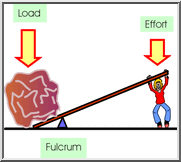
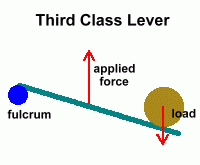
Que: What is the 1st class, 2nd class & 3rd class lever?


It uses a fulcrum in between, and the applied force and load are at opposite ends.
________________________________________________________________


The second class lever is one where the fulcrum is at one end, and the applied force at the other. The load that is to be moved is between them.
________________________________________________________________


The fulcrum is once again at one end of the lever, but this time the load is at the other end, and you apply a force in between.
________________________________________________________________